
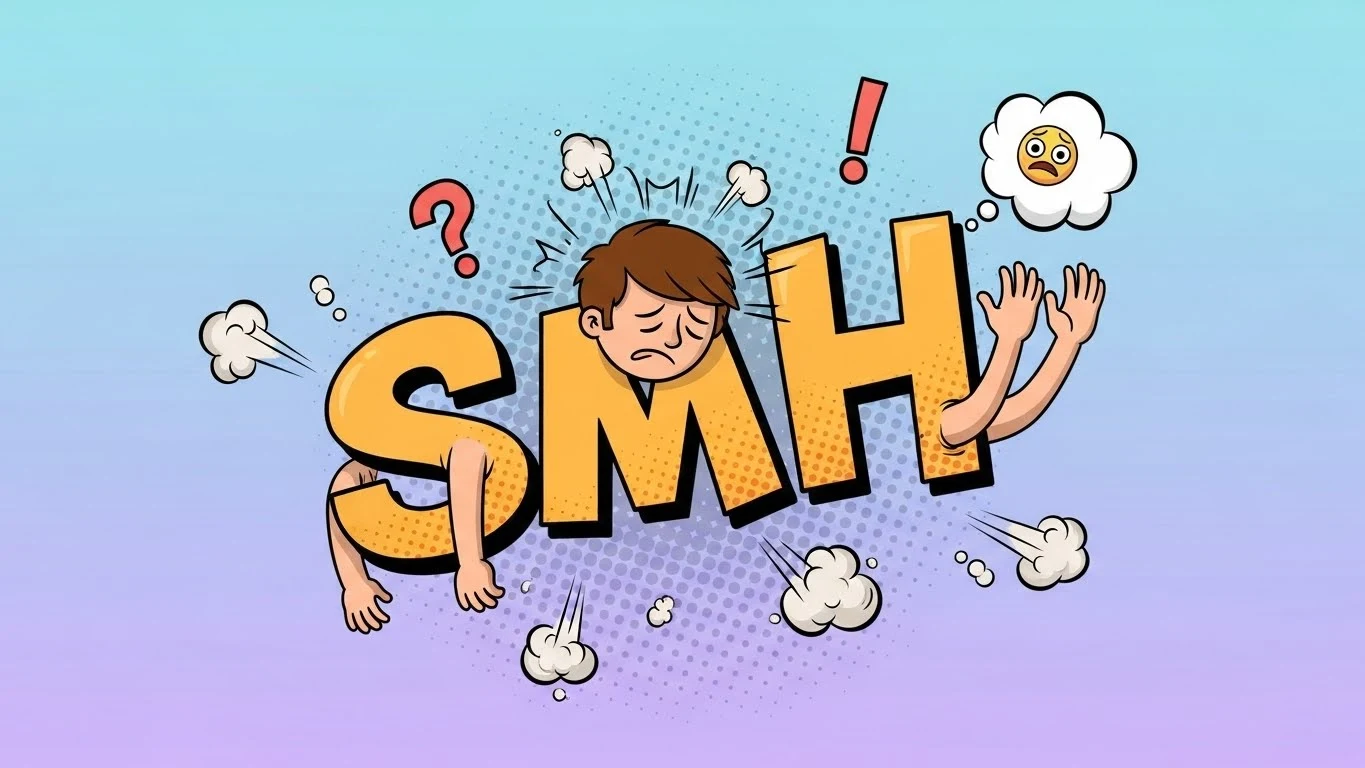
In the fast world of texting, reactions have become their own language. Instead of typing full sentences, people rely on quick abbreviations and keyboard slang to express feelings instantly.
One of the most viral and widely used expressions online is SMH. You’ve probably seen it on TikTok, Instagram comments, group chats, or even in memes.
It shows up when people are frustrated, disappointed, annoyed, or simply can’t believe the situation. But what does it truly represent? And how do you use it without sounding weird or out of context?
Let’s break it down in the simplest and most Gen-Z friendly way so you’ll never be confused again.
⚡ Quick Answer
SMH = “shaking my head.”
It’s used to express disappointment, frustration, annoyance, or disbelief — basically when words aren’t enough and you’re mentally shaking your head at someone or something.
Why SMH Became So Popular
Abbreviations have always existed online, but SMH became especially popular with the rise of meme culture and social media. It perfectly captures one universal human reaction: the silent head shake that happens when someone does something silly, cringe, or unbelievable.
Think of SMH as the digital version of rolling your eyes.
It isn’t aggressive… but it does say a lot.
Platforms where you’ll see it most:
- TikTok comments
- Twitter/X replies
- Instagram chats
- Snapchat streaks
- Reddit threads
- Discord gaming chats
- Memes and reaction GIFs
The Core Meaning: “Shaking My Head”
It conveys silent emotional reactions
SMH isn’t loud.
It’s the quiet, disappointed “bro… seriously?” type of response.
It often means:
- “I can’t believe this.”
- “That was dumb.”
- “I’m speechless in a bad way.”
- “This situation is embarrassing.”
It’s NOT about anger or hate.
It’s about disbelief or judgment (light or heavy depending on tone).
How SMH Is Used in Text and Online
There are two typical ways SMH appears in conversations:
1️⃣ On its own
When someone doesn’t need extra context.
Example:
Friend: I missed my exam because I overslept again.
You: smh
The abbreviation alone does all the emotional work.
2️⃣ With extra explanation
When you want to show why you’re disappointed.
Example:
- Smh, why would you do that?
- Smh, people really think this is okay??
- Smh at how bad that play was.
It pairs perfectly with an eye-roll emoji, a facepalm GIF, or sarcastic tone.
SMH Variations and Upgrades
SMH has evolved into multiple versions.
Here are common variations you’ll see:
SMFH — Shaking my f***ing head
A stronger version. The emotion is more intense, usually used when someone is incredibly frustrated.
Example:
“SMFH… how did you lose $200 on crypto in one day?”
SMH in silence
Uses no punctuation.
Conveys disappointment through stillness.
Example:
smh
SMH + emojis
A classic addition for drama.
- “smh 🤦♂️”
- “smh bro 😭”
- “smh this world 🤷♀️”
Emojis amplify tone.
Common Scenarios Where SMH Makes Sense
Here are real-life situations where people naturally use SMH:
When someone is being dramatic
“Smh, you’re crying over a 2-day talking stage.”
When someone ignores advice
“Smh, I told you not to trust that guy.”
When someone makes the same mistake repeatedly
“You failed the exam twice and didn’t study? Smh.”
When watching cringe or dumb content
“TikTok comments after a failed influencer prank: SMH.”
Gaming fails
“Bro ran into the enemy without armor 💀 smh.”
Celebrity scandals
“Another apology video dropped… smh.”
Public social media chaos
“Influencers arguing in comments? smh.”
SMH Is Not Always Mean
Even though SMH can sound judgmental, it can also be:
Playful teasing
Example:
“You ate 12 cookies? smh.”
Friendly roasting
Besties use it daily.
Example:
“Smh you’re literally addicted to online shopping.”
Mild disappointment
Nothing dramatic, just a vibe.
What SMH Does Not Mean
A lot of people misunderstand this shorthand.
Let’s clarify.
SMH does NOT mean:
- “so much hate”
- “so much heat”
- “send me help”
- “someone help”
(Although people sometimes use it jokingly that way)
If you’re trying to express confusion or fear, smh isn’t the right choice.
How SMH Affects Tone in Messages
Text abbreviations don’t have facial expressions, tone of voice, or body language.
So SMH carries meaning through context.
Tone can shift:
- Funny → “smh you’re so dramatic 😂”
- Soft → “smh why are you like this lol”
- Serious → “smh you really lied about that.”
- Cold → “Smh.”
- Aggressive → “SMFH that’s wild.”
One abbreviation.
Many emotional layers.
When to Use SMH (and When Not To)
Use it when:
- You’re reacting casually.
- You’re commenting on something dumb or cringe.
- You’re roasting a friend.
- You’re disappointed lightly.
- You’re reacting to a social media post.
Avoid it when:
- Someone is dealing with trauma.
- A situation is genuinely serious.
- You want to be supportive.
If your friend is heartbroken or grieving, don’t respond “smh.”
It can feel insensitive or dismissive.
Examples for Every Platform
Texting
“You forgot your wallet again? smh.”
Snapchat
Someone posts their breakfast at 4 p.m.
“Smh you never wake up on time.”
Comment on a meme:
“smh this generation 😂”
TikTok
Reply to a messy story:
“smh they really did her dirty.”
Gaming
“Bro died 3 times in the tutorial smh.”
Work group chat
“Team forgot the deadline… smh.”
Simple.
Short.
Universal.
Where SMH fits in online culture
Abbreviations like SMH exist because digital communication is faster than ever.
Instead of writing a whole paragraph, people compress emotions into 3–4 letters.
SMH is part of the same ecosystem as:
- LOL
- OMG
- TBH
- IDC
- WTF
- FR
- IDK
These acronyms turn texting into a shorthand language.
It’s not lazy — it’s efficient and expressive.
History: Where SMH Originated
SMH didn’t start with TikTok or Gen-Z.
It comes from early internet culture, especially forums and instant messaging in the late 2000s and early 2010s. Social platforms like Twitter, Tumblr, and early meme communities helped it explode.
Eventually it moved into:
- texting
- viral memes
- reaction videos
- pop culture
Now it’s mainstream.
Even parents use it… sometimes incorrectly 😅
SMH in Meme Culture
Memes are the perfect home for SMH.
Why? Because memes exaggerate reactions.
Classic meme templates:
- Someone making a bad decision → SMH
- Someone ignoring obvious advice → SMH
- A ridiculous news headline → SMH
A meme doesn’t even have to show a shaking head.
The text alone sets the tone.
The Psychology Behind SMH
SMH works because it’s relatable.
Everyone has experienced that silent headshake moment in real life.
The abbreviation gives people:
- A non-confrontational form of criticism
- A way to express disbelief without yelling
- A way to be annoyed but funny at the same time
It’s passive-aggressive in a lighthearted way.
Digital sarcasm, executed efficiently.
SMH vs. Similar Internet Slang
People often confuse SMH with similar reactions.
SMH vs. LOL
- LOL = laughing or finding something funny.
- SMH = not amused, disappointed.
Totally opposite emotions.
SMH vs. IDC
- IDC = “I don’t care.”
- SMH = “I care enough to be disappointed.”
SMH vs. Facepalm 🤦
SMH is emotional.
Facepalm is physical.
You can even combo them:
smh 🤦♀️
SMH vs. WTF
- SMH = “That was dumb.”
- WTF = “That was shocking.”
Both valid, but very different.
Advanced Usage: Tone + Context + Emojis
To sound natural online, combine SMH with modern digital cues:
- smh bro… 😭
- Smh I told you not to do that 💀
- smh this world is wild 😭🤦♂️
- Smh why is this so accurate 😂
Tip: lowercase tends to feel funnier or more casual.
Uppercase makes it harsher.
Final Thoughts
Language evolves with culture.
SMH isn’t just an acronym it’s a digital reaction. It’s the universal emoji-less eye roll, the disappointed sigh in text form, and the online version of “I’m not mad… just disappointed.”
Use it when something is silly, annoying, cringe, or unbelievable.
Don’t overuse it in serious situations.
And remember: tone and context matter more than letters.

Chloe Evans is the creative soul behind the heartfelt stories and magical moments shared on this anniversary journey. Passionate about celebrating love, Chloe brings together the beauty of timeless relationships through inspiring narratives, photography, and personal experiences. With a deep appreciation for the milestones that define true love, Chloe’s words capture the essence of enduring bonds and the joy of every anniversary moment.