
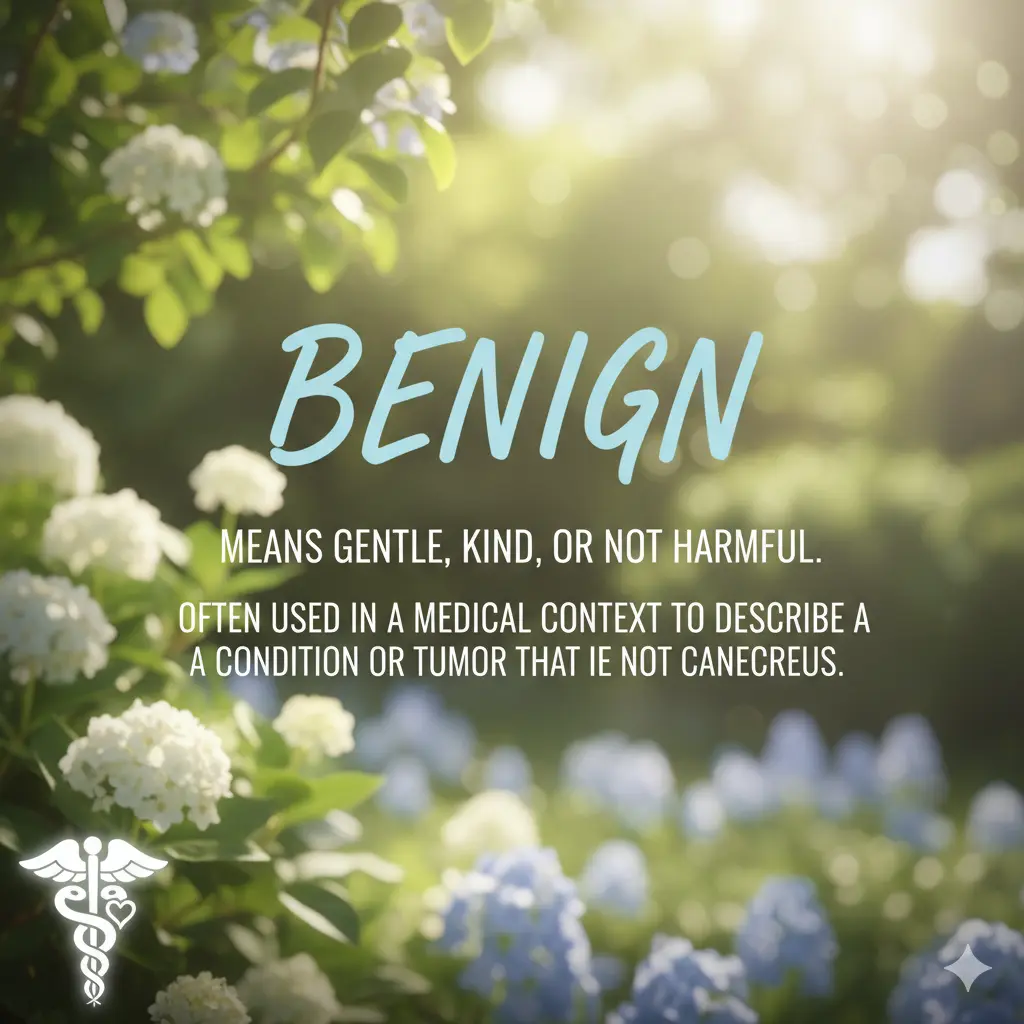
Have you ever been reading something online—maybe a medical report, a news article, or even a science TikTok and suddenly you see the word “benign” pop up? For a second, your heart drops. I remember seeing it the first time and panicking because I had no idea whether it meant something serious or harmless. If you’ve been in that same moment of confusion, don’t worry—you’re definitely not alone!
Let’s make it simple:
👉 Quick Answer: Benign means “harmless or not dangerous.”
It’s often used in medical, scientific, or everyday contexts to describe something that won’t cause harm, especially a non-cancerous tumor.
🧠 What Does Benign Mean in Text?
The word benign means safe, gentle, or not harmful.
In medicine, it usually describes a condition or growth that is not cancerous and doesn’t spread.
Simple example sentence:
“The doctor said the tumor is benign, which means it’s not dangerous.”
⭐ In short: Benign = Harmless = Not cancerous (in medical context).
📱 Where Is the Word “Benign” Commonly Used?
You’ll often see the word benign in:
- 🏥 Medical reports & doctor visits
- 📚 Science or biology classes
- 🧪 Health articles
- 📄 Lab results
- ☑️ Online research about symptoms
- 📰 News or informational posts
- 💬 Everyday conversation when describing behavior or effects
✨ Tone:
- Formal
- Neutral
- Professional
- Calm & reassuring
💬 Examples of “Benign” in Conversation
Here are 6 simple, real-life examples:
- A: “Did you get the biopsy results?”
B: “Yes, thankfully it’s benign!” - A: “Is that type of spider dangerous?”
B: “No, it’s pretty much benign.” - A: “Should I be worried about this lump?”
B: “Probably not — most are benign but get it checked.” - A: “What did the doctor say?”
B: “It’s a benign condition, nothing serious.” - A: “Is email tracking harmful?”
B: “Most of it is benign, just analytics.” - A: “His comments seemed rude.”
B: “No, I think they were benign, not meant in a bad way.”
🕓 When to Use and When Not to Use “Benign”
✅ Use “Benign” When:
- Talking about medical test results
- Describing something gentle or harmless
- Explaining a condition that isn’t dangerous
- Clarifying that something poses no threat
- Reassuring someone
❌ Don’t Use “Benign” When:
- Talking casually in slang conversations
- Describing something urgent or dangerous
- Trying to be humorous (it’s a serious word)
- Messaging friends casually — too formal
- Explaining something that does pose risk
Comparison Table
| Context | Example Phrase | Why It Works |
|---|---|---|
| Medical Report | “The growth is benign.” | Precise, formal, reassuring |
| Doctor to Patient | “Your results are benign—no danger.” | Clear & comforting |
| Formal Writing | “The effect of the policy is benign.” | Neutral & academic |
| Everyday Chat | “Don’t worry, it’s benign.” | Reassuring |
| Casual Slang | (Avoid) | Too formal for slang chats |
🔄 Similar Words or Alternatives
| Word | Meaning | When to Use |
|---|---|---|
| Harmless | Not dangerous | Everyday conversation |
| Noncancerous | Not cancer | Medical understanding |
| Mild | Not severe | Symptoms or effects |
| Gentle | Soft, kind | Behavior or tone |
| Safe | Without risk | General use |
| Innocuous | Not harmful | Formal writing |
❓ FAQs About “Benign”
1. Does benign mean cancer?
No. Benign means NOT cancerous.
2. Is benign always good?
Mostly yes — it means harmless. But anything benign should still be monitored medically if it’s a growth.
3. What’s the opposite of benign?
Malignant, which means harmful or cancerous.
4. Can benign tumors grow?
Yes, but they do not spread like cancer.
5. Is benign a medical term only?
No, it’s also used in everyday life to mean harmless or gentle.
6. Does benign mean safe?
Yes — it implies no danger.
7. Is the word formal or casual?
It’s generally formal and used in professional contexts.
Conclusion
The word benign is one of the most reassuring words you can come across in medical or scientific contexts. Knowing it means harmless and not cancerous can instantly calm your nerves.
Whether you’re reading test results, researching symptoms, or coming across it in a book or conversation, now you’ll understand exactly what it means and when to use it confidently.

Chloe Evans is the creative soul behind the heartfelt stories and magical moments shared on this anniversary journey. Passionate about celebrating love, Chloe brings together the beauty of timeless relationships through inspiring narratives, photography, and personal experiences. With a deep appreciation for the milestones that define true love, Chloe’s words capture the essence of enduring bonds and the joy of every anniversary moment.